
By the Abstract team
The new contract is signed. There will be more shipments, more suppliers, and more people making decisions. Production capacity is accounted for in the plan. Meanwhile, onboarding each supplier depends on a spreadsheet maintained by one person. Last-minute changes arrive through WhatsApp, and the status of each request is confirmed by phone.
At today's volume, the team makes it work. With twice the workload, the same way of operating starts consuming hours that no one included in the growth forecast.
You do not have to wait for a crisis to see the problem. As a company grows, so does the number of approvals, exceptions, handoffs, and data points it must coordinate. A process that seemed good enough can become the limit on the entire operation.
At Abstract, we help companies find that limit, understand why it appears, and decide what to change. Sometimes the answer is to clarify responsibilities. Other times, systems need to be integrated or a missing capability needs to be built. That decision starts well before choosing a technology.
How to spot a bottleneck before it holds back growth
A bottleneck is a step that limits how much work a process can complete. The rest of the company may be ready for more demand, but everything waits for that step to catch up.
It can hide in an unremarkable place. Someone has to check documents before granting access. Someone else collects records before a service can be settled and paid. A team reviews messages to confirm which order changed and which one can go out. Each task looks small until it happens hundreds of times and starts holding up the rest.
Processes involving outside parties often feel this pressure first. Suppliers, carriers, and contractors do not all use the same system or work the same hours. Add business rules, expiring documents, and decisions that must be recorded, and every increase in volume brings more coordination.
The useful question is simple. If the workload doubled tomorrow, which step would require another hire just to keep doing the same work?
The signs show up in everyday work
A spreadsheet or WhatsApp group is not a problem by itself. It becomes a warning sign when it holds information the process needs to move forward and no one can easily reconstruct what happened.
Pay attention if several of these sound familiar.
- Only one person knows which file is current or who can resolve an exception.
- Different teams have different versions of the same status.
- The same data is entered into more than one system.
- Coordinating the task takes longer than doing it.
- Expired, missing, or incomplete documents are discovered only when someone needs to move ahead.
- An error comes to light only when it is time to bill, pay, answer a complaint, or prepare for an audit.
- Every increase in volume is handled by adding people to repetitive work.
- Answering “Where does this stand?” requires calling several people.
- An exception is resolved in a chat, but no one records the decision afterward.
These signs do not automatically mean you need custom software. They show you where to look. The next step is to check how much work builds up, whom it affects, and what would happen at a higher volume.
A one-hour map to find the step limiting your operation
Choose a recent operation that reached completion, ideally one with a change or an exception. It could be supplier onboarding, preparing a shipment, or approving a payment. Bring in someone who knows how the work actually gets done, not only how the procedure says it should be done.
First, draw where the process begins and ends. Then note every person and system involved. Mark each moment when work waited for an answer, changed hands, or required someone to copy information. Finally, identify decisions made outside the systems and where, if anywhere, those decisions were recorded.
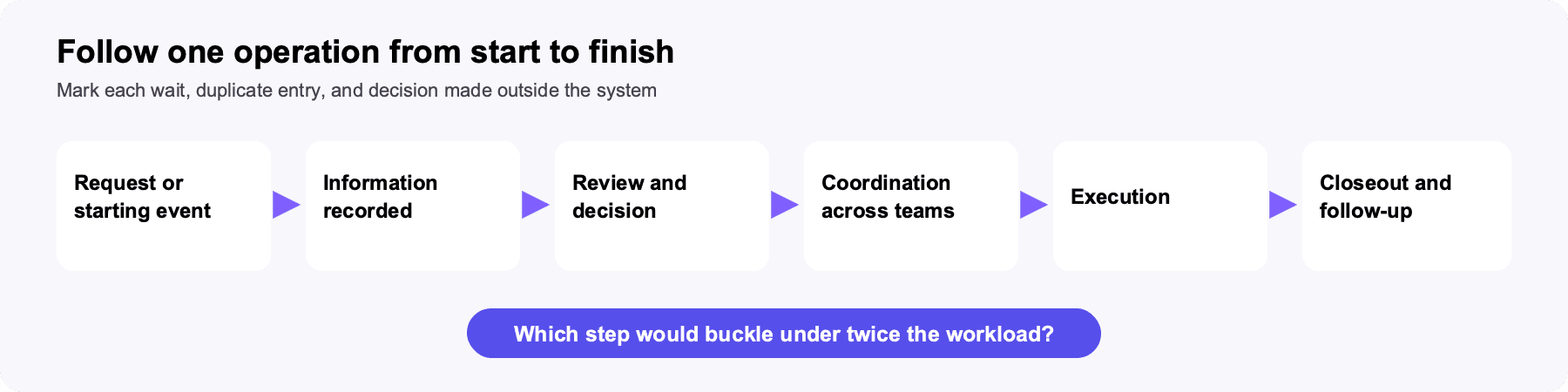
This diagram starts the conversation. The useful map is the one that reflects a real case in your company.
Two questions help uncover what the diagram may miss at first. “Where do you lose the most time?” and “What are you worried will fail when the workload increases?” The person doing the work often points to a dependency that does not appear in the formal procedure.
After an hour, you should have a visible path through the process, not a technical specification. That is enough to choose which step to investigate with data.
Test the process against the volume ahead
Now return to the map and change one condition. Imagine twice as many requests, more locations, or an additional shift. Ask how long each step would take, how many decisions would wait for the same person, and what information new participants would need.
You do not need to invent a savings figure to run this test. Look at recent operations and measure how often data was entered twice, work waited, corrections were made, or people searched for information. That baseline lets the team estimate which workload would grow and check the estimate later.
The cost of failure matters too. A delay in an internal report has a different effect from a truck stopped by a pending approval or a delivery that cannot be confirmed. Frequency, time, and impact help set priorities.
The process causing the most frustration is not always the first one to fix. The strongest candidate is often the one that repeats, holds up other teams, and gets worse under projected growth.
What can you automate, and what should you organize first?
Once you find a candidate, examine four things. Does it repeat according to a recognizable pattern? Are there rules the team can explain? Do several people or systems take part? What does it cost when a decision is late or wrong?
Clear answers may reveal an opportunity to simplify or automate part of the process. You still need to choose how. Defining an owner and a shared status may be enough. An existing product may cover the work if configured well. If the systems already do their jobs but do not exchange information, integration may be the answer. If the operation has its own rules and no available product covers them reasonably well, custom development is worth evaluating.
A sound diagnosis also recognizes exceptions that require human judgment. Adding a button does not make them disappear. A useful solution surfaces the case, gathers its context, and lets someone decide without losing traceability.
The same applies to AI. It can help classify requests, find information, or prepare actions, but it needs reliable data, clear limits, and a way to review what it does.
What we have learned from real operations
At Cementos Bío Bío, Abstract worked on scheduling and coordinating trips among several participants, with access rules, system integration, and traceability. At Red de Alimentos, we addressed receiving, inventory, allocation, and distribution across a network with many participants.
These are different operations. Both show why useful software starts with understanding decisions, statuses, and the relationships among people and systems. Those capabilities help a process run repeatedly without relying on someone to reconstruct its status by hand.
These cases do not establish a universal point at which a spreadsheet stops being useful. That point depends on volume, rules, and the impact of each operation. This is why we start with the real process and the conditions under which it needs to grow.
If everyone comes to you for answers, the bottleneck has reached your desk
Growth may still be in the plan. Or it may have already happened, and you spend your days putting out fires. If you lead a team and spend the day confirming statuses, clearing approvals, or finding the right spreadsheet, that work takes time away from the next decision your business needs.
You do not need to come with a solution. Bring a process that depends too heavily on you or your team, or one you worry about as volume grows. At Abstract, we can walk through it with you, find where work piles up, and assess what change would help you regain control.