By the Abstract team
The application is live, and the team uses it every day. Then a question comes up that was never part of the launch project. A user cannot finish a task. An integration returns an unexpected status. An update raises concerns about what it might affect. None of these situations is unusual. They are part of running software that supports real work.
Some days leave even less time to investigate. A company launches a digital campaign, but the responses it expected do not arrive. Was it the send, the integration, the page, the data, or how results are measured? The campaign keeps running while someone looks for the cause.
That is why support is about continuity, judgment, and knowledge of the operation. At Abstract, we stay with platforms after launch. We receive issues, investigate what is happening, coordinate the people who can act, and help the system evolve with the business.
Support begins long before an outage
An ordinary week may bring user questions, access reviews, configuration changes, data errors, or behaviour that appears only under certain conditions. Resolving these cases well means understanding what the person was trying to do and which other parts of the process depend on that action.
A useful answer goes beyond “it works now.” It should explain what happened, what was done, and whether anything should be prevented or changed. When several teams use the same platform, that context keeps the next person from starting the investigation all over again.
Everyday support also reveals opportunities to improve the product. If the same question arrives every week, the interface may need a clearer explanation. If an exception always needs manual intervention, a business rule may be worth revisiting. Support requests show how people really use the software.
When a digital campaign stops delivering
The campaign has to launch today. The team prepared the assets, committed the budget, and expects responses. It goes live, minutes pass, and nothing comes in. Sales asks whether leads are arriving. Marketing can see clicks but cannot tell what happened next. Who do they call to find out whether the problem is in the ad, the page, or the system receiving inquiries?
At that point, you need someone who understands the urgency and takes charge of finding out. Our team follows the journey with the people running the campaign, finds where it stops, and explains what is happening. If another provider owns part of the journey, we coordinate that review. If the flow can be corrected or restored, we act within the agreed scope and check the result.
For the person leading the campaign, the difference is having an answer and an owner while there is still time to make decisions. Support connects the right people, organizes the information, and follows the issue until everyone knows whether the operation is working again.
When the system supports an operation that never stops
Now think about an operation that continues after office hours. A trip needs to be coordinated in the middle of the night. A driver needs to know whether they can proceed. Someone checks a status, and the platform does not respond. The person in charge cannot wait for a help desk to open on Monday to find out what to do.
At Cementos Bío Bío, the platform we built coordinates trips, participants, and rules in a continuous operation. The case materials describe 24/7 operation and support. For a client in that position, support matters when an exception appears and they know where to ask for help, who will take the case, and what information they will receive to act.
Not every problem has the same urgency. A question about how to use a feature can wait for a scheduled review; a stopped essential function needs a different path. That is why we agree with each client on what is critical, how it is reported, and whom to alert. For services with this coverage, the initial response arrives in under an hour and usually within minutes.
A quick response means someone has taken ownership, understood the impact, and started moving the issue toward a resolution. That may require a workaround, engineering work, or coordination with another provider. The client needs to know what is happening throughout, rather than watching an unowned ticket sit in a queue.
Automating intake without losing human judgment
When a support message arrives, the first job is to understand what happened. Often the person reporting it is in the middle of work and does not know which details the technical team needs. Making them repeat the story to three people only adds delay.
That is why we have introduced automation and AI into support services for other clients. They help receive the request, gather context, recognize a known issue, and suggest where it should go. A simple problem may get an assisted answer. If anything is uncertain or the operation is affected, the on-call team receives the case, reviews what the AI did, and takes control. No one should be trapped in a conversation with a system that cannot solve their problem.
This combines human work with specific tools. Our internal platform alerts us when a case arrives and puts it in front of the right team. We adapt to the channel each client already uses to request help, without forcing them to overhaul how they work.
- Flexible support channels such as WhatsApp, Microsoft Teams, or Telegram to receive and continue conversations in ways that fit the client's operation.
- Alerts for the support team through our internal platform. The on-call team can receive Slack notifications and, when a case requires it, escalate as far as a phone call using Twilio.
- Automation with n8n to connect requests, the information needed to resolve them, and follow-up tasks.
- AI models from OpenAI and Anthropic, or alternatives such as Google's Gemini and Meta's Llama, chosen according to the problem and the client's conditions. They can help interpret messages, organize context, and prepare an initial response.
- Knowledge and tracking in tools such as Jira, Confluence, or ClickUp, depending on the organization. A technique such as retrieval-augmented generation, or RAG, can bring relevant procedures to the person handling a case when reliable documentation exists.
Listing tools does not solve a support problem. The expertise lies in deciding what each tool can do, what a person must review, and how a case reaches the right specialist. That brings speed without giving up judgment or accountability. The specific workflow depends on each client's operation and systems.
Support matters even when nothing seems to be broken
The best support conversation may be the one nobody had to have. That is why we review security updates, dependencies, certificates, and infrastructure before a failure reaches users. We plan changes, check their effects, and care for platforms as they evolve.
That work is also part of our relationships with clients such as Parque del Recuerdo and Constructora Gardilcic. An app used by field teams, an administrative platform, or an integration that keeps changing all need attention after delivery. Updating components and reviewing security help sustain them, but also require product knowledge so everyday work is not interrupted.
Preventive support does not make for a dramatic story. Its value is that teams can keep working while the software stays current.
Questions you should be able to answer about your current support
Think about the last problem that affected an important task. Where was it reported? Who recognized that it was urgent? How long did it take to reach someone who could act? Was there enough information to reproduce it? Was the solution recorded?
If finding those answers means searching several chats or remembering who was on call, we can help organize the service. Abstract can handle first contact and classification, address specialized technical issues, and bring in engineering when complex components need attention. In other words, we can cover L1, L2, and L3 support according to what your operation needs. When the issue originates in another system or with another provider, we can coordinate and route it to the right specialist without losing track of the case.
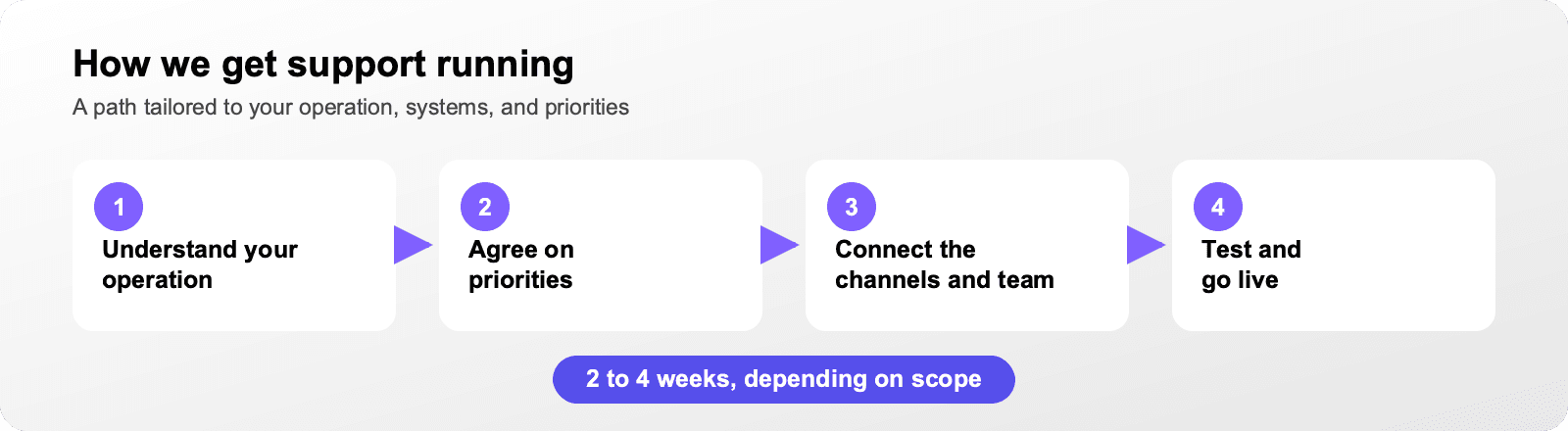
You do not need to wait for a major failure to begin. We review your platforms, people, channels, and priorities together. Depending on scope and available access, we can join your operation and have support running in two to four weeks. From there, the service covers everyday requests, critical interventions, and preventive care.
The following path shows how we can start working together. We adapt each stage to your platforms and your team's responsibilities.
If you are the one who ends up chasing answers whenever something breaks, let's talk. We can design support that knows your operation, responds with judgment, and stays with the software as your business uses and changes it.