By the Abstract team
Knowing how much stock is in a warehouse is only part of the problem. A distribution network also needs to decide who receives it, how orders are prepared, and how to track each product as it moves among organizations, systems, and delivery points.
At Red de Alimentos, these decisions are part of an operation that connects contributing companies with social organizations. Technology needs to support receiving, inventory, and product distribution across a network with many participants and allocation conditions.
At Abstract, we approached the challenge from the operation itself. We observed warehouses and delivery points, studied processes, roles, and exceptions, then designed and built a custom warehouse management system, or WMS. The solution brings together inventory, orders, picking, deliveries, master data, integrations, and traceability.
This project shows what it means to build software around an organization's operating model.
A logistics network with decisions at every stage
Red de Alimentos brings together warehouses, social organizations, food pantries, suppliers, and delivery points. In that setting, information helps determine what comes in, how it is identified, what is available, who receives it, and what goes out.
The need was to strengthen the central system supporting that operation, known as Red Virtual, so donations, inventory, and distribution could be managed with greater visibility and control.
The project background described friction in the user experience, repetitive manual tasks, and difficulty obtaining clear information. Architectural limits also made integration and future development harder.
The challenge therefore had several dimensions. We needed to understand the process the organization depended on, improve how people used the system, and build a technology foundation that could support the work.
A warehouse solution also had to account for the entire network. Participating organizations have needs and capacities that affect distribution. Products come from different sources, and their codes must be reconciled. Allocation has to respect both availability and constraints.
The design had to reflect these relationships so the system could become a tool for the people running the operation.
On-site Discovery to see how the work actually happens
The definition phase included observing warehouses and delivery points. That gave us a way to understand real processes, roles, and exceptions before turning them into product requirements.
A broad request to “manage inventory” still leaves many decisions open. On site, you see who is involved, what information they use, and which conditions allow a movement to continue. That knowledge clarifies what the system must do and how it should present the work.
For a WMS, that understanding runs through the whole workflow, from receiving and stock management to orders, picking, and dispatch. It also shows how warehouse tasks relate to the needs of other organizations and teams.
For Red de Alimentos, the definition and architecture work addressed the operation as a connected whole. The aim was to shape a core platform that could be managed, integrated, and developed further.
This phase is valuable because of the decisions it settles. What information must be shared? Which rules does the process need? What should the first solution include? Once those questions have answers, development starts from a functional foundation that can be discussed and validated.
Connecting inventory, orders, and distribution
The project's purpose was to build a platform suited to Red de Alimentos' logistics model, with traceable processes and an experience that supports its users.
Its objectives combined operational and technical capabilities.
- Connect receiving, inventory, orders, and dispatch.
- Bring consistency to products and codes from different sources.
- Include allocation rules that reflect how the network works.
- Improve visibility and traceability across the process.
- Establish a technology foundation for integration and future development.
Each depends on the others. Allocating products requires reliable availability. Managing that availability requires consistent product identification. Understanding a delivery requires a connection between stock, order, picking, and dispatch.
Abstract's contribution is a connected operational core
1. A WMS shaped around the organization's workflow
We designed and built a platform that brings together receiving, inventory, orders, picking, and dispatch. Picking is the physical preparation of the products in an order. To carry it out and record it, the team needs clear information.
The system includes roles, reporting, and self-service configuration capabilities. These help organize work around responsibilities and let each profile manage the parts of the platform within its scope.
Traceability connects the stages. Instead of treating each movement as an isolated data point, the solution relates it to the process it belongs to.
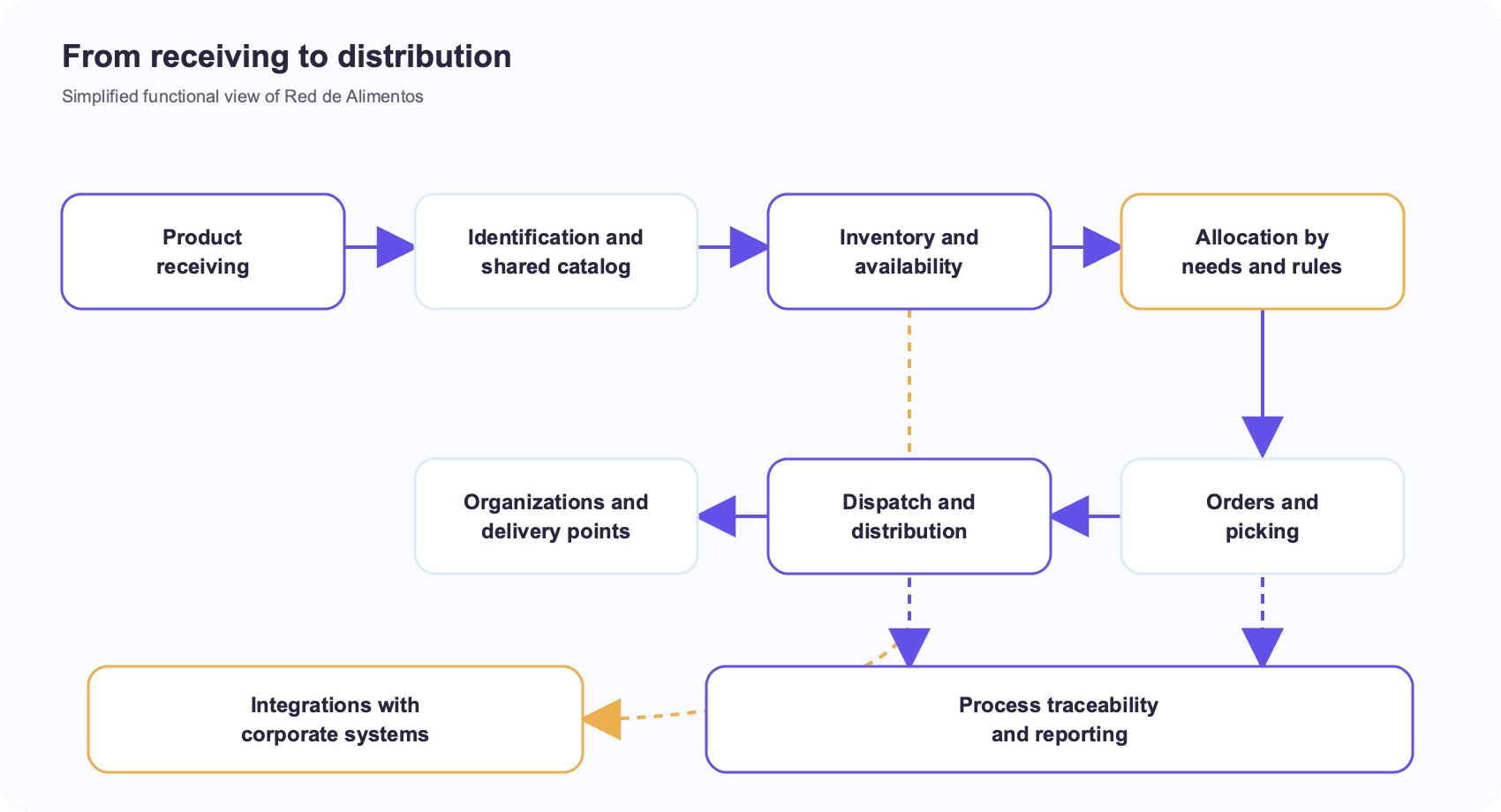
The illustration summarizes the capabilities involved. It is a simplified functional view; the specific rules and exceptions determine the path each process takes.
2. Master data and integration for a shared foundation
Products and codes from different contributors need to be reconciled. That means establishing how different identifiers relate within a common catalog.
At Abstract, we worked on that standardization alongside integrations with corporate systems. Master data provides shared references so the different parts of the platform use consistent information.
This has direct operational consequences. Product identification affects what is received, what appears as available, and what can be included in an order. The quality of the data model is therefore part of business design as well as technical implementation.
Integration connects this core with the existing environment. It lets the project organize the flow of information between the tools involved in the operation.
3. Allocation rules adapted to the network
The solution includes an allocation algorithm that considers availability, needs, consumption capacity, and restrictions.
That capability reflects the network's operating model. Distribution requires evaluating conditions related to both the product and the organizations receiving it. The system has to represent those rules to support allocation.
Building them into the platform connects distribution decisions with inventory and orders. It also makes those decisions easier to discuss and maintain as the product evolves.
A live platform with documented scale
The project materials highlight these figures to convey the scale of the operation.
An SKU is a distinct product reference in the inventory. The number gives a sense of the variety managed, while the organizations and locations show other dimensions of the network.
Together, these figures show the range of products, participants, and locations connected through the platform.
For a buyer, the lesson is practical. Technology must be designed around how many people take part and which decisions they need to coordinate, as well as the volume flowing through the system.
Architecture that can evolve with the operation
The work included data modelling and architecture design for Red Virtual's evolution. Its structure needed to support integrations and new capabilities as the operation changed.
For a business that relies on a central platform, architecture decisions have practical consequences. They shape how the product can be changed, connected, and maintained.
In this case, the operational core is accompanied by support and ongoing development. Knowledge accumulated about rules, users, and data provides context for that later work.
The technology follows the project's needs. The guiding principle is the relationship among the operation, its users, and the information needed to make decisions.
What other organizations can learn from this case
Our work with Red de Alimentos shows how to approach inventory and distribution when complexity is spread across multiple organizations, data sources, and rules.
On-site observation creates a shared understanding. Master data brings consistency to the references used across the process. The WMS connects the stages of work, and allocation rules link availability to the network's needs.
This combination reflects our experience in understanding an operation, defining its relationships, and building a platform to manage them.
Let's talk about your inventory and distribution
If your organization needs to coordinate warehouses, orders, systems, and delivery points, we can help you assess what is happening and what to solve first.
At Abstract, we design and build custom solutions, integrate existing tools, and support platforms as each operation evolves.
Tell us where coordinating your inventory and distribution becomes difficult.