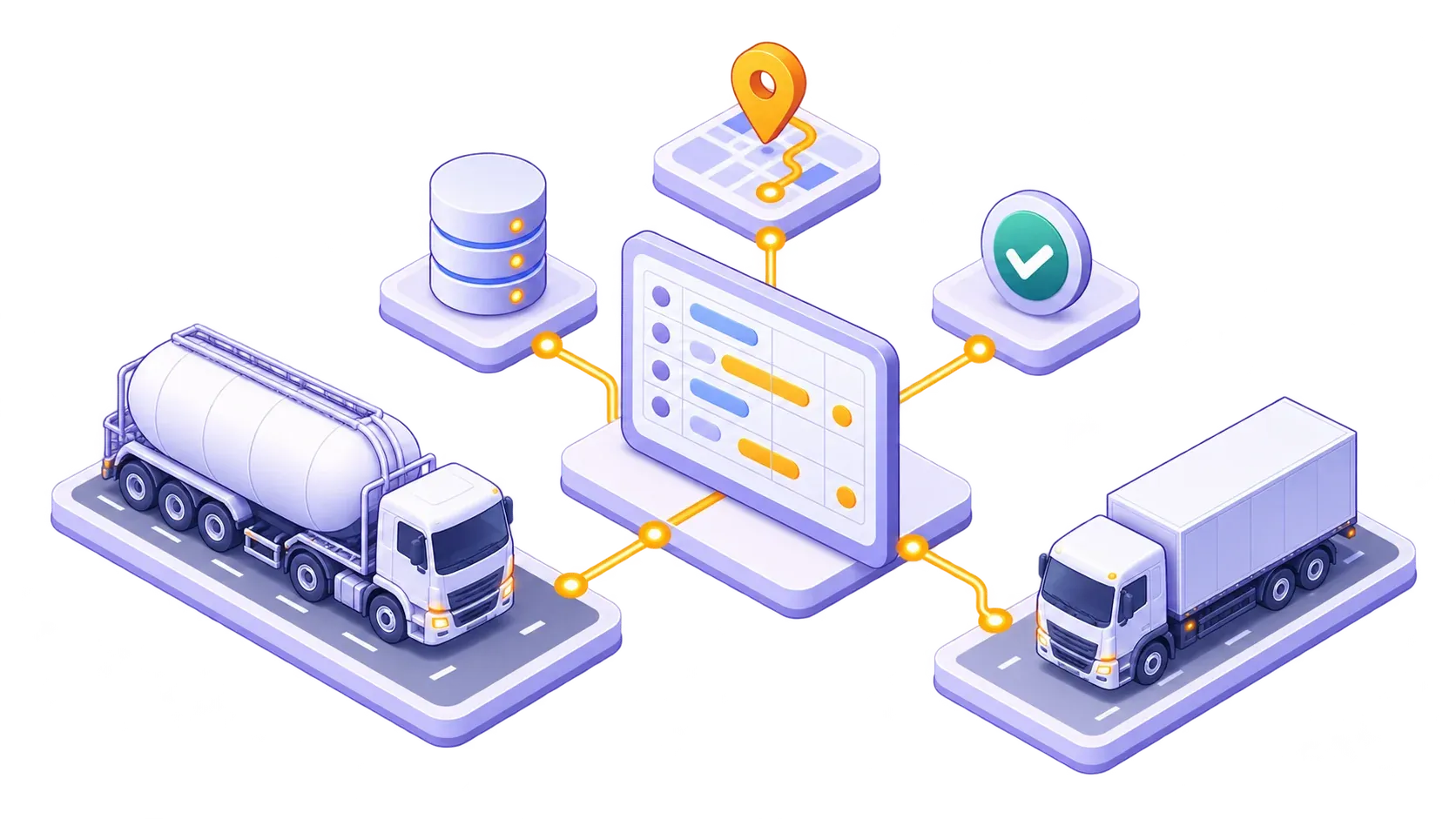
By the Abstract team
A trip can be scheduled and still be unable to proceed. Between planning and execution, people, requirements, statuses, and decisions all have to line up. When each participant holds only part of that information, coordinating transport means piecing the whole picture together again and again.
That was the kind of complexity we tackled with Cementos Bío Bío, or CBB. Its operation transports critical supplies for industry and mining. It involves multiple people in the field, access rules, and systems that must stay in sync.
At Abstract, we worked from understanding the process through designing and building a platform to schedule trips, coordinate participants, and maintain traceability. The challenge was to turn the business's real rules into a solution people could use while the operation was running.
One trip, one shared view across the operation
In logistics, scheduling is only the beginning. Coordination continues when conditions change, an exception appears, or someone needs to confirm what they can do next.
CBB needed to digitize and centralize that work. The operation involved different roles, processes with limited standardization, and dependencies between systems. Together, these made it harder to see and coordinate a flow that matters to the business.
The project had to address three connected needs. First, structure trip scheduling. Second, bring internal and external participants together around shared statuses and rules. Third, retain a record of what was happening and how each process had progressed.
The platform also had to connect with existing systems and be clear enough for people working in the field. Each design decision had to account for both operational complexity and how easily each person could complete their task.
Coordination improves when people and systems can interpret the same situation using consistent criteria.
That principle shaped the work.
Before building, understand what lets a trip proceed
We began with Discovery, design, and architecture to understand the roles, workflows, rules, and exceptions involved.
In a project like this, a scheduling screen only makes sense once the decisions behind it are understood. You need to establish what information each participant needs, what they are responsible for, and which conditions change a trip's status.
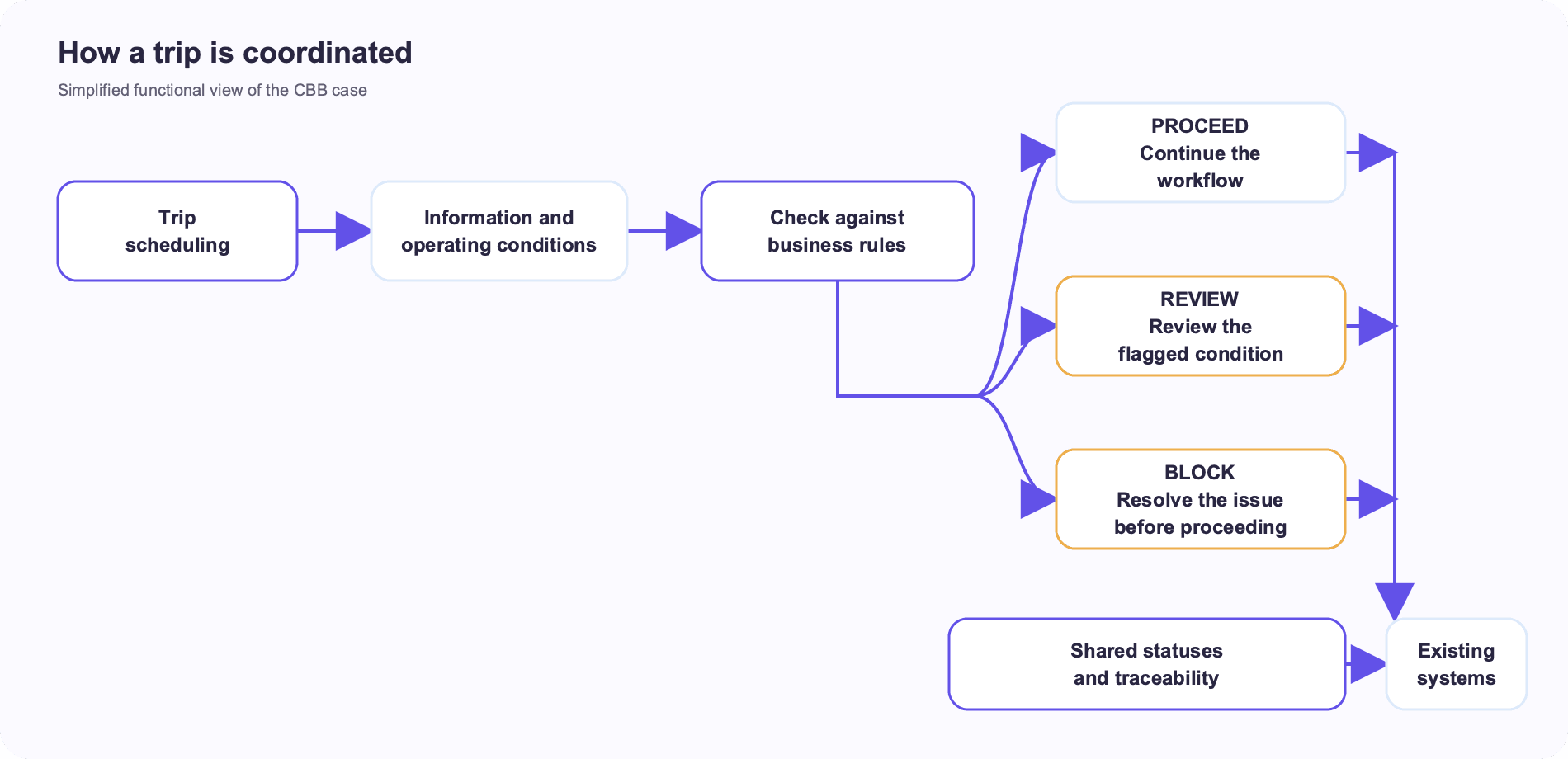
A central part of the work was defining when an operation should be allowed to proceed, flagged for review, or blocked, and how that decision should appear across the systems involved.
The design questions are practical. What does it mean for a trip to be ready? Which condition needs review? Who needs to know when something changes? How do you preserve the context of what happened? Answering them creates a shared logic that can then be built, tested, and used.
This work also makes the scope concrete. A request such as “we need traceability” becomes actionable when it is expressed as statuses, events, user roles, and relationships between systems. “We need better coordination” becomes capabilities a team can design and validate.
A common foundation for scheduling, coordinating, and controlling trips
The project's aim was to digitize and standardize the logistics operation, connect its participants, and make the process visible.
That led to clear working objectives.
- Centralize trip scheduling and control.
- Coordinate internal and external participants through shared logic.
- Integrate the systems involved in the operation.
- Keep a traceable record across every stage.
- Make the platform practical for use in the field.
These objectives reinforce one another. Scheduling creates value when it supports coordination. Coordination needs consistent statuses. Traceability shows how those statuses changed. Integration lets that information work with the client's existing technology.
Three capabilities working together
1. Trip scheduling and coordination
We designed and built a platform to manage trips, participants, and processes from a central operation. It brings together trip scheduling, role-based administration, and operational control.
The design starts with each role's responsibilities. People need the information and actions relevant to their work, while managers need a view of the whole process to coordinate everyone involved.
Standard workflows help people follow a shared way of working. At the same time, modelling exceptions makes room for situations that call for a different decision. A system needs both to support a real operation.
2. Access rules within the workflow
Operational conditions are part of the platform's logic. Depending on the rules, a situation can allow the process to continue, trigger a warning, or block it until the issue is resolved.
This turns business knowledge into system behaviour. It also makes the user experience important. Each person needs to understand the current status and what it means for their task.
The illustration shows how these capabilities relate to one another. It is a simplified functional view of the case.
3. Integration and traceability across systems
The platform integrates with existing systems, unifies statuses, and synchronizes information in the background. This connects transport coordination with the information the rest of the operation needs.
In an operational integration, what the data means matters as much as moving it. If two systems interpret the same status differently, transferring it does not solve the coordination problem. That is why rules, design, and integrations were treated as parts of one solution.
Traceability brings the process history together. It provides context for reviewing what happened and understanding the links between scheduling, participants, and operational decisions. Indicators add a management view to that visibility.
The scale behind the solution
Abstract's case materials report the following figures for the platform in production.
These figures convey the scale and continuity of the operation the solution supports.
They also put the challenge in perspective. This system is part of an operation with many movements and users, where rules, integrations, and usability must work together.
For a company considering a similar project, the useful question is which part of its own coordination needs that level of consistency. It may be scheduling, access rules, visibility, follow-up, or the connection between systems. Defining that need helps focus the investment.
24/7 support. The work continues after go-live
CBB's solution includes support for a continuous operation. Going live begins a stage in which knowledge of the process remains essential.
An incident has to be examined in the context of the system, the data, the rules, and the user's situation. Understanding how those elements relate helps diagnose what happened and coordinate the right response.
It also helps the product evolve with context. When the operation changes, a new feature has to fit with existing roles, statuses, integrations, and earlier decisions. Preserving that knowledge is part of the value of supporting an enterprise platform over time.
Support coverage and terms are defined for each service. In CBB's case, the documented work combines development, integration, and ongoing operational support.
What this project shows about how we work
CBB shows how Abstract turns an operation involving many people and exceptions into an integrated platform that can be used in the field.
The work connects three layers. At the business level, we understand what needs to happen and under which conditions. At the product level, we turn that understanding into a clear experience and scope. At the technical level, we build the capabilities and integrations that sustain it.
That connection guides our decisions. The process tells us what the solution needs; the experience of the people using it gives it a workable shape; and the architecture has to support both daily use and future change.
Let's talk about the process you need to coordinate
If your operation depends on multiple participants and systems, we can help you see where visibility is lost, which rules need to be shared, and what technology approach is worth evaluating.
At Abstract, we work with you to define the problem, design the solution, and connect the technology to the operation it must support.
Tell us how you currently coordinate trips, deliveries, or critical processes.